Few places on earth carry the weight of history the way the Giza Plateau does. Rising just southwest of Cairo, this stretch of desert has been an object of wonder, scholarship, and pilgrimage for millennia. Long before modern tourists arrived with cameras, ancient Greeks and Romans came to marvel at the same structures we see today, and were just as speechless. For any traveler visiting Egypt, Giza is not optional. It is the beginning.
This guide walks you through the key monuments of the Giza Plateau, what makes each one extraordinary, and what to expect when you visit. Whether you are planning your first trip or returning for a deeper look, ancient Giza always has more to reveal.
(1) The Great Pyramid of Khufu (Cheops):
The Last Standing Wonder of the Ancient World · c. 2560 BCE
The Great Pyramid of Khufu, known to the ancient Greeks as Cheops, is the oldest and largest of the three main pyramids on the Giza Plateau, and the only one of the original Seven Wonders of the Ancient World still standing. Built around 2560 BCE as the tomb of the Fourth Dynasty pharaoh Khufu, it originally stood at 146.5 metres (481 feet) and held that record as the world's tallest man-made structure for nearly 3,800 years.
The pyramid is made of an estimated 2.3 million stone blocks, each weighing between 2.5 and 15 tonnes. Modern archaeology and engineering studies continue to debate exactly how it was built, the logistics of quarrying, transporting, and precisely placing that volume of stone remain one of history's most fascinating puzzles. What is beyond debate is the result: a structure of breathtaking precision, with the base aligned to true north with an accuracy that would challenge modern surveyors.
Visitors can enter the interior of the Great Pyramid and walk through its ascending passage to reach the King's Chamber, a granite-lined room at the heart of the structure where Khufu's sarcophagus once rested. The passage is steep and the space is tight, but the experience of standing inside a 4,500-year-old royal tomb is unlike anything else on earth.
- Allow 1.5–2 hours
- Separate entry ticket to enter interior
- Best visited at sunrise
* Traveler's Tip
Interior access to the Great Pyramid requires a separate ticket, sold in limited numbers daily. Buy it first thing in the morning, they often sell out by mid-morning, especially in peak season.
(2) The Pyramid of Khafre
Khufu's Son · c. 2530 BCE
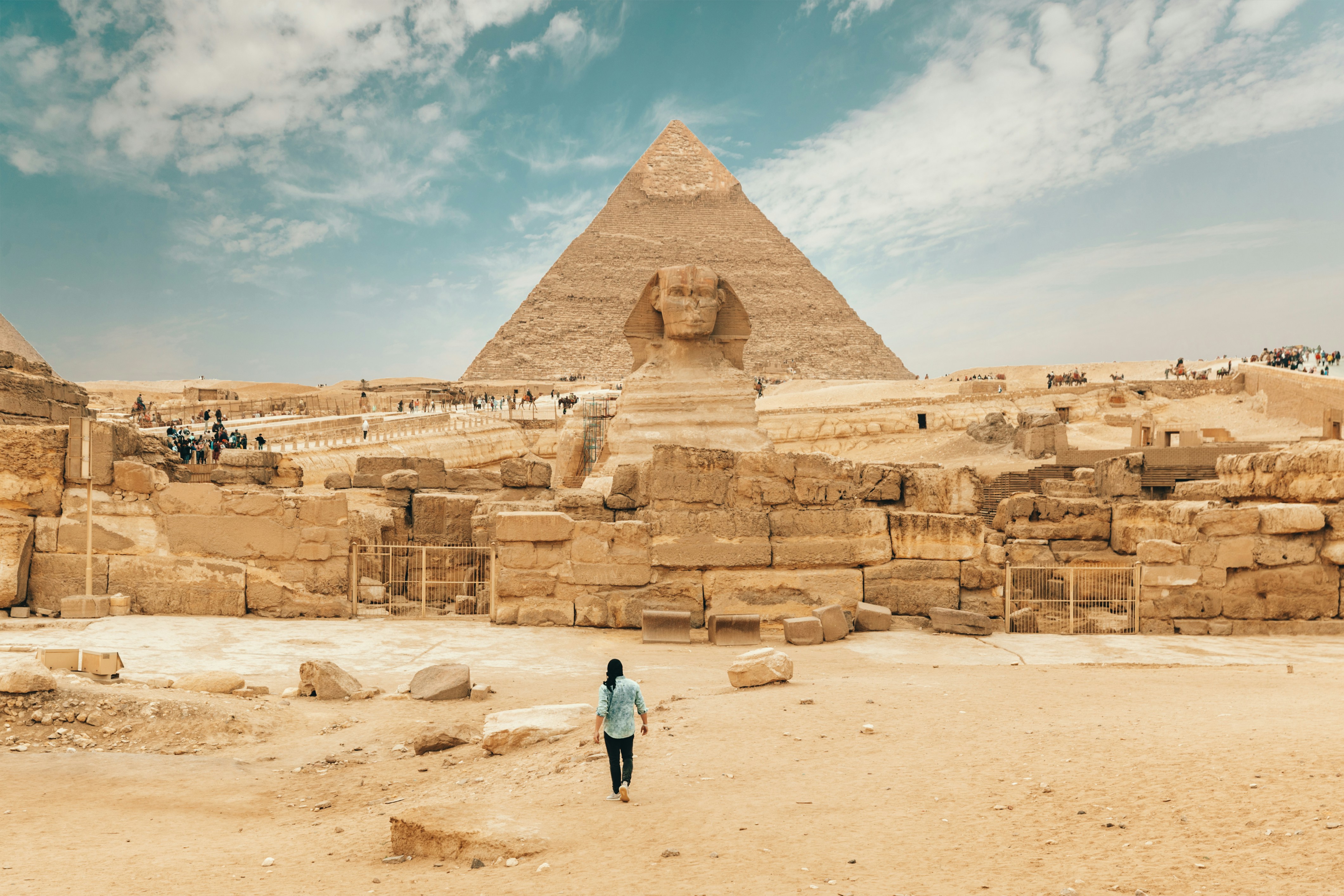
The Pyramid of Khafre, built for Khufu's son, is the second-largest on the plateau and arguably the most visually striking from a distance. Its peak still retains a cap of the original white Tura limestone casing stones that once covered all three pyramids, giving a rare glimpse of how these monuments appeared in their original gleaming state. From certain angles, Khafre's pyramid appears taller than Khufu's, though this is an optical illusion created by its higher elevation on the plateau.
The complex surrounding Khafre's pyramid is particularly well preserved and includes his Valley Temple, one of the oldest surviving temples in Egypt, connected by a long causeway to the upper Mortuary Temple. These structures hint at the elaborate funerary rituals performed for the pharaoh over the years following his death.
- Allow 1 hour
- Valley Temple worth visiting
(3 )The Pyramid of Menkaure
The Smallest of the Three · c. 2510 BCE
Menkaure's pyramid is the smallest of the three main Giza pyramids, yet in many ways the most humanly scaled and approachable. Built for Khafre's son, it stands at about 65 meters and was originally encased partly in red granite from Aswan, giving it a distinctly different character from its neighbors. The interior is accessible and includes a decorated burial chamber.
Flanking Menkaure's pyramid are three smaller subsidiary pyramids built for his queens, adding a sense of family and continuity to what might otherwise feel like a purely monumental landscape. Together, the three main pyramids and their surrounding complexes form a unified royal necropolis that was a center of religious activity for centuries after the pharaohs themselves were buried there.
- Allow 45 min
- Best photography angle from here
✦ ✦ ✦
(4) The Great Sphinx
Guardian of the Plateau · c. 2500 BCE
Carved directly from a single ridge of natural limestone, the Great Sphinx is the largest surviving monolithic sculpture in the world, 73 meters long, 20 meters high, with the face of a pharaoh (most likely Khafre) and the body of a lion. It gazes eternally eastward, toward the rising sun, embodying the ancient Egyptian concept of royal power merged with divine protection.
Despite millennia of erosion, repeated burial by desert sands, and deliberate vandalism over the centuries, the Sphinx remains a profoundly powerful presence. Standing at its base and looking up at its weathered face, you feel the full span of time that separates its creation from the modern world, and yet it endures.
Between the paws of the Sphinx stands the Dream Stele, a carved stone tablet erected by Pharaoh Thutmose IV around 1400 BCE. The inscription records a dream in which the Sphinx appeared to the young prince and promised him the throne of Egypt if he cleared the sand that buried its body. It is one of the earliest pieces of evidence that by the New Kingdom, the Sphinx was already ancient and revered as a sacred monument.
- Allow 45 min
- Featured in the Sound & Light Show
- Best light at golden hour
(5) The Solar Boat Museum
A Pharaoh's Vessel for Eternity · Discovered 1954
On the southern side of the Great Pyramid lies one of Egyptology's most remarkable discoveries: a dismantled wooden boat, buried in a sealed pit beside the pyramid and reassembled after its discovery in 1954. Known as the Khufu Ship or Solar Boat, it measures 43.6 meters in length and is one of the oldest and best-preserved vessels in the world.
The boat was likely intended to carry Khufu's soul on his journey through the afterlife, either accompanying the sun god Ra across the sky, or sailing in the celestial realm beyond death. Seeing it up close, with its elegant cedar planks and papyrus-rope lashings still intact after 4,500 years, is a deeply affecting experience that brings the human side of ancient Egyptian belief vividly to life.
- Allow 30–45 min
- Separate entry fee
- Climate-controlled museum
(6) The Giza Plateau Tombs & Mastabas
The City of the Dead · Old Kingdom
Surrounding the three main pyramids is a vast necropolis of mastabas, flat-roofed rectangular tombs built for the nobles, officials, and family members who served the pharaohs. These are often overlooked in favor of the more famous monuments, but they are extraordinarily rewarding for those who venture into them. The walls of these tombs are covered in colorful painted reliefs depicting daily life in the Old Kingdom: farming, fishing, feasting, music, and ritual. They offer an intimate human window into a civilization that the bare grandeur of the pyramids alone cannot provide.
- Allow 30–60 min
- Often crowd-free
Practical Information
Getting There:
The Giza Plateau is located about 20 km southwest of downtown Cairo. Taxis, Uber, and organized tour buses all serve the site. The metro connects to Giza station, from which a short taxi ride reaches the plateau.
Opening Hours & Tickets
The plateau is open daily from 8:00 AM to 5:00 PM (4:00 PM in winter). Entry tickets cover the plateau and pyramids exterior; interior access, the Sphinx enclosure, and the Khufu Ship Museum each require separate tickets.
Best Time to Visit
October to April offers comfortable temperatures. Arrive at opening time to beat the crowds and catch the soft morning light on the pyramids. Avoid midday in summer, the heat is intense and the plateau offers little shade.
Sound & Light Show
An evening Sound & Light Show is held at the Sphinx, narrating the history of the pharaohs in multiple languages against a backdrop of illuminated monuments. A memorable way to end a day on the plateau.
Before You Go
Wear comfortable, closed shoes, the terrain is uneven and sandy. Bring water, sunscreen, and a hat. Agree on taxi prices before getting in, and be prepared for vendors near the site who can be persistent but are generally harmless. A licensed guide adds enormous value here; the stones alone tell only part of the story.
The Giza Plateau does something to you that is difficult to articulate until you have stood there. The sheer age of it, the fact that these structures were ancient when Julius Caesar visited, when Napoleon arrived with his scholars, when the first photographs were taken, places you inside a timeline so vast that your own life feels both small and, paradoxically, precious. Go. Stand in the shadow of the Great Pyramid at dawn. Let 4,500 years of silence speak to you.
AttractionsMay 25, 2026